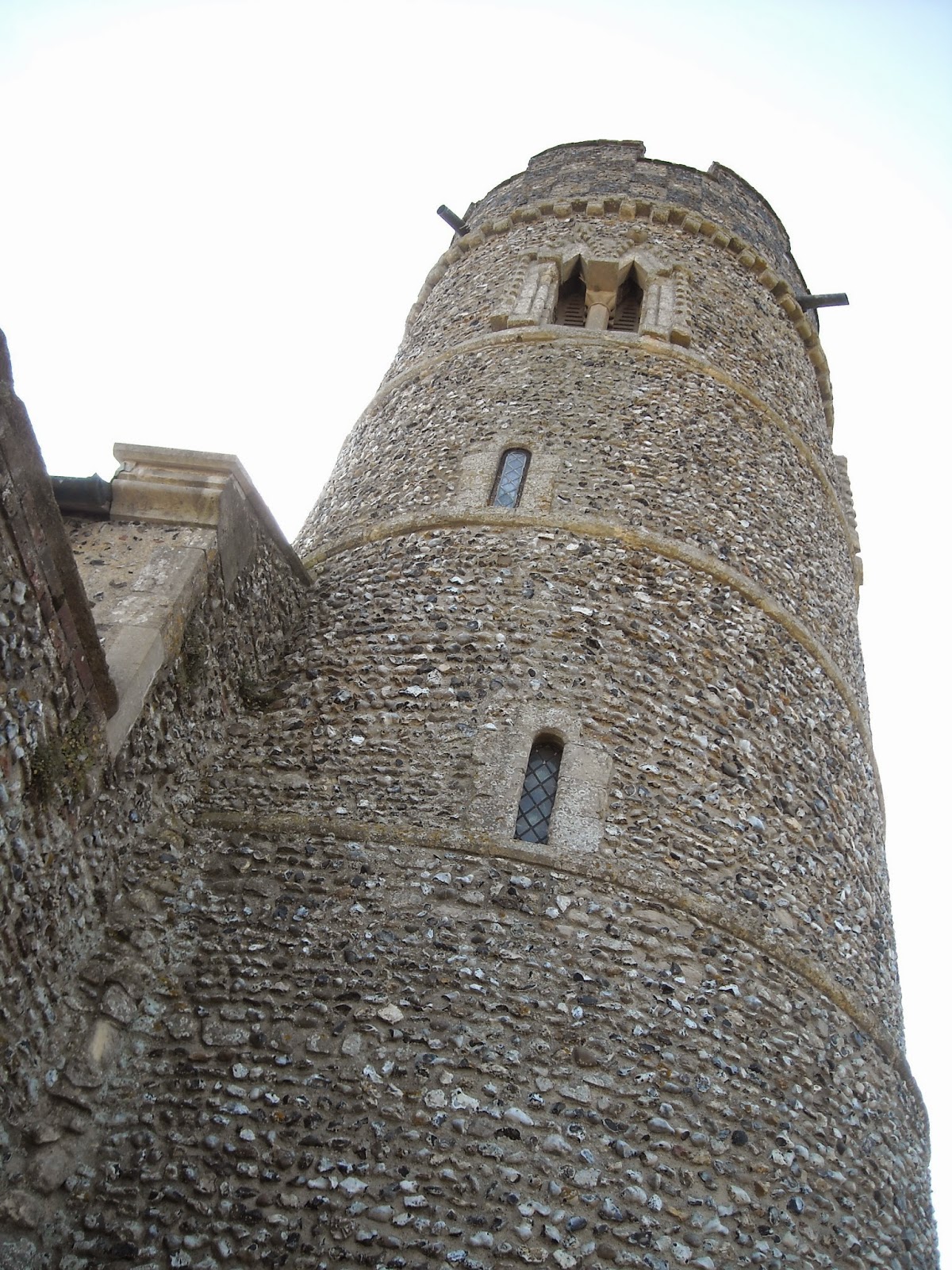
I have visited the priory at Thetford once before back in September 2013 and have made an entry about it which you can read here.
During my initial visit I noticed a small gate to one side of the site near to the nave of the priory buildings. The gate which was padlocked shut, was set into a low wire fence and had a little signed saying 'This way to the gatehouse' painted on it. I wanted to investigate on my first visit but as mentioned above it was unfortunately locked shut.
However during my second visit a couple of weeks ago I found the gate to be unlocked. This time I noticed a second sign informing me that the pathway was open to visitors to the gatehouse, but no exit from the site could be made this way. I noticed as I walked along the path that I was in fact walking through the front garden of 'Abbey House' which is a private residence. I was greeted by a dog and a gentleman who said hello and not to worry about the dog, she is very friendly really. I thanked him and said hello in return. He went on about his business in his garden.
I approached the gatehouse and was pleased that I had plucked up the courage to walk through, even though I had permission to be there I felt as though I was being intrusive.
The gatehouse today is a grade 1 listed ruin and is still fairly intact yet is missing some of its features such as inner walls, floors and roof. It is clear to see from the flint work and stone dressings that this gatehouse was a grand building and would have provided a impressive entrance to visitors and impressive sight to those who lived in the town. The upper levels of which the gatehouse had two, were used to receive rents. These floors were accessible using the staircase located in one of the buttresses. Evidence of the stairs is visible even though the stairs have seen eroded away.
While most of the priory precinct wall has disappeared or been demolished some still remains and evidence of a barn can be seen on the outside of the gatehouse in the form of a V which formed the joint with the barn roof.
I would recommend a visit to the priory and to the gatehouse as even though the gatehouse is mainly a shell now it is still an impressive sight to behold and will have you in awe over how the medieval craftsman ship created a lasting building almost 800 years on.
Background information and reading credited to English Heritage available at www.english-heritage.org.uk
Tuesday, 17 March 2015
Creake Abbey
I recently visited Creake Abbey a short drive up the road from North Creake, not far from Fakenham in North West Norfolk. I had visited this site once before and while some of the former monastery buildings and site has since been developed into private residences, it felt oddly strange and eerie as though I was being watched.
However this time I did not get this feeling, yet it was replaced with another feeling, a feeling of sadness. Now this could be due to the information I had read about the site before hand so I am not saying that I experienced anything paranormal. I owe these feelings to its history and that fact that during 1484 Creake abbey was destroyed after a tragic fire reduced it to nothing more than a large church in physical size. The community at Creake Abbey was wiped out canon by canon until in 1506 the last member of the community the Abbot himself died from the plague.
A little history of Creake Abbey
Creake Abbey went from strength to strength starting life as a small chapel which grew into a hospital and priory. Sir Robert de Narford funded the chapel of St Mary of the Meadows to be built and later extended to become the hospital and priory of St Bartholomew. At this point we know the canons began to follow the rule of St Augustine.
The priory began to prosper with donations from many generous benefactors such as King Henry III by bestowing the title of abbey onto the complex in 1225. However the canons were unaware that this prosperity would not last and in 1484 tragedy befell that abbey when it was gutted by a fire which ripped through the building reducing the complex to a mere shell of it former glory. Requests were made to fund the rebuilding programme at the site. King Richard III made donations yet these were not enough to rebuild its prosperity especially when further tragedy fell on the abbey in 1506. One by one the canons died from the plague with the abbot being the final inhabitant left also died from the plague in 1506
My feelings on the site
As I strolled around the site I found it tranquil yet also a feeling of sadness fell over me which as I mentioned earlier I attributed to the information I read on the boards dotted around. I got a sense of the 'good' Sir Robert and Lady Alice tried to accomplish by founding this abbey and hospital and also the glory that this site must of radiated in its heyday.
However a feeling of uncertainty flooded me as I approached some of the original features due to their new and current use. In the photos below you will see the piscinas that were once used to wash the vessels used in daily services are now filled with 'offerings' such as candles, Christian psalms and texts along with stones scribed with messages such as 'RIP Uncle.' I found this to be comforting that people are still using the site as a place of remembrance but also oddly strange as both times I have visited I have been the only person there.
I would certainly recommend a visit to the site to see what feelings you receive from such as place and while you are there use the benches dotted about to pause and reflect and take in the beauty of nature around you, listening to the birds singing as they wing about in the sky.
Just around the corner is a delightful cafe and craft shops which are also well worth a visit.
Background research and reading credited to English Heritage available at www.english-heritage.org.uk
Labels:
1206,
Abbey,
Augustinians,
Chapel,
church,
Creake,
Creake Abbey,
fire,
Hospital,
King Henry III,
Lady Alice,
Plague,
Richard III,
Sir Robert De Narford,
St Augustine,
St Bartholomew,
St Mary of the Meadows
Wednesday, 7 January 2015
At the top of the tower (Happisburgh Church)
So today (18th October 2014) I visited Happisburgh and as I entered the village I saw a sign telling me that the church tower was open so I thought what a fantastic opportunity. I of course stoppped to take a look an I am so glad I did. I had visited Happisburgh and the church before however I only managed to take a look around the interior and the exterior of the church.
St Mary's at Happisburgh stands on top of a hill over looking the village and the fast approaching sea as it gradually eats away and erodes the cliff edging nearer and nearer to the church yard year on year.
So I entered the church to find a man sitting behind a small desk at the bottom of the tower taking the small charge for access to the stairs which was £1. A bargain I thought. He showed me the stairs and warned me to call up as I climbed as their radio system has broken down so he was unable to warn the warden up top the I was coming up.
So I stepped through the door way and started to climb the very narrow spiral staircase. I climbed and climbed what felt like a lifetime, and I was beginning to get slightly panicked as I climbed. I normally do not get worried about heights too much but there were small glass windows in the stairwell on the way up and it felt that I had very quickly left the ground and was very high up, it felt very disorienting.
On my way I saw the bells which were very impressive and finally I came to chamber above the bells where the stone spiral staircase stopped and new memorial metal spiral staircase started which took you up to the roof. Finally I broke through and made it to the to where I saw daylight again. Now when I went up the weather was slightly overcast and slightly breezy but the views were absolutely amazing. For a while it took a while to get used to being up there as the roof was slightly slopped which made it feel like I was falling over when walking around up there.
I am so pleased I went up there to take in these breathtaking views which I have included below. I will gradually and eventually post my photos from my original visit to the church.
So I can post these photos as I eventually made it back down the stairs again which again my heart leapt into my throat as they were very steep and several times I felt I was going to fall over.
Sunday, 12 October 2014
St Mary's Haddiscoe
So here we have St Mary's Haddiscoe, and what an amazing treasure this is. I was told about this church by a family member and so decided when out that way one day to take a look. As I approched it, it sat atop the hill like a beacon of peace and hope to all around it.
As I mentioned above St Mary's sits on a hill and when you approach it, it looks very impressive with its round tower and checkerboard pattern around the top. From reading the information in the church itself, it is belived the tower and almost certainly the base dates from the Saxon period.
As you approach the doorway, their is a stone carving depicting possibly a saint. Whoever it is, the carving is very impressive giving some idea as to the wealth or pride this parish had for their faith.
Again inside this church does not cease to amaze with the remains of wall paintings that are still visible today. The carved stonework continues throughout the building and it is very impressive how decorative this church is. The ironwork on the door into the church made me feel like I was entering a building from Lord of the Rings, an elven house or a Gondorian hall.
Again the clerstory windows beautifully shaped, reminding me of a four leaved clover.
When I visited Haddiscoe church, it was a bright, sunny day which made the building ooze with grandness but not in a pompous way. It showed how much pride the parishioners had for their place of worship. Even though the main road runs very close to the bottom of the hill, the church and the churchyard around it was very peaceful. I could have spent hours just wandering the site, enjoying the tranquility. It was a place of pure peace and beauty.
It is clear to see that this church is still a beacon to all as it is well maintained and cared for and is still in use for regular worship.
Labels:
Anglo Saxon,
beacon,
beauty,
Carving,
church,
clestory windows,
East Anglia,
Eleven,
Haddiscoe,
Lord of the Rings,
Norfolk,
parish church,
peaceful,
Round Tower,
Saxon,
St Mary's,
Stone Work,
Wall Paintings
Subscribe to:
Posts (Atom)